We published 2,500 posts in a month. Google throttled us.
We shipped about 2,500 posts to Versely in one month. Google crawled them and left many out of the index. What happened, and the ~20/day pace we use now.
Published 6 min readBy the LaunchRanked team
- seo
- content
- case study
- indexing
In August we turned our content engine all the way up on Versely, our AI video and content creation app. We published about 2,500 posts in one month. The writing was fine. The pipeline was fine. Google was not impressed.
Pages got crawled, then sat outside the index. We call it a throttle. Google doesn't use that word, but that's what it felt like from our side of Search Console.
Short answer: Publishing thousands of pages at once can get your indexing throttled. When we shipped about 2,500 posts in a month, Google crawled many but didn't index them. We now publish about 20 posts a day, gate every draft for duplicates, and noindex near-duplicates.
This post is the honest version: what we did, what we saw, what we changed, and the rules we'd give any founder about to scale content. The full Versely story, with the Search Console chart, is in our case study.
What we built before the mistake
Versely's SEO wasn't a pile of AI posts. By the time we scaled, the site had a real technical base: a metadata and canonical helper, JSON-LD (Organization, Breadcrumb, FAQ, Article, SoftwareApplication, VideoObject), a sitemap index with honest lastmod dates, a generated llms.txt, and tracking for AI crawlers.
On top of that sat two engines:
- Programmatic page families built from typed data: audience pages, alternatives, X vs Y comparisons, a glossary, cost pages and model pages.
- An AI content engine. Each article started from Search Console data, went through a research digest, then a strict writer contract: a short title, a minimum length, FAQs, at least three internal links, and sourced facts.
The engine could produce far more than a person could review. That was the point. It was also the problem.
What happened when we went fast
We published roughly 2,500 posts in August. Crawling kept up. Indexing didn't.
The Page indexing report in Search Console filled with URLs marked Crawled – currently not indexed. Google's own definition of that status is blunt: "The page was crawled by Google but not indexed. It may or may not be indexed in the future; no need to resubmit this URL for crawling." (Search Console Help)
That's the part founders miss. Crawled doesn't mean accepted. Google fetched the page, looked at it, and decided it didn't need it yet.
There's a sibling status worth knowing: Discovered – currently not indexed. Google says this typically means it wanted to crawl the URL, but "this was expected to overload the site; therefore Google rescheduled the crawl." If you see that one growing, Google is rationing its visits, not just its index.
Why Google slows a site down
Google's crawl budget guide explains that crawl demand "varies based on a site's size, update frequency, page quality, and relevance, compared to other sites." (Optimize your crawl budget) Quality is in that sentence for a reason.
Now picture the site from Google's side. A domain that published at a modest pace suddenly adds thousands of pages in a few weeks. Many target closely related queries. Some overlap heavily with each other.
Google's spam policies describe scaled content abuse as "when many pages are generated for the primary purpose of manipulating search rankings and not helping users," and name "using generative AI tools or other similar tools to generate many pages without adding value for users" as an example. (Spam policies)
We weren't trying to game anything. But a sudden burst of AI-assisted pages on related topics looks like that pattern from the outside. The sensible response from Google is to slow down and wait for evidence. That's what it did.
Our read, which we can't prove from the outside: Google judged the batch as a whole before judging each page.
What we changed
We didn't stop publishing. We changed how.
1. A pace ceiling of about 20 posts a day
We now publish around 20 posts a day on Versely. That number is ours, not Google's. It's what our domain can absorb while the indexing report stays healthy. A newer domain should start lower. The rule is simple: speed up only when new pages are getting indexed, and slow down the moment "Crawled – currently not indexed" starts climbing.
2. Quality gates before anything ships
The gates exist because of August. Every draft now has to pass:
- Similarity and duplicate checks against everything already on the site, so two pages never answer the same query.
- Internal-link checks, so each page links to real, relevant pages and gets linked from somewhere. Orphan pages are easy to crawl past.
- The writer contract: a title that fits in search results, enough depth to beat what's ranking, FAQs, at least three internal links, and sourced facts.
A draft that fails a gate doesn't get "fixed later". It doesn't ship.
3. Noindex near-duplicates
Some page families produced pages that were too close to each other. We noindexed the near-duplicates instead of hoping Google would pick the right one. If you don't choose, Google chooses for you. Search Console calls that "Duplicate without user-selected canonical", and the page it picks may not be the one you wanted.
4. Keep sitemap dates honest
We already did this one, but it matters more at volume. Google says it uses lastmod "if it's consistently and verifiably (for example by comparing to the last modification of the page) accurate." (Build a sitemap) Stamping every URL with today's date to look fresh teaches Google to ignore your dates. Ours change only when the content does.
The biggest win wasn't new content
Here's the part that surprised us most. The largest gains didn't come from publishing more. They came from rewriting titles and snippets on pages that already ranked on page 1 or 2.
The mechanism is simple. Search Console shows pages with plenty of impressions and few clicks. Those pages have already passed Google's quality bar. They're just not getting chosen. A title that matches the query people actually typed, says what the page delivers, and fits on screen earns more clicks from the same impressions.
Google's own guidance points the same way: write "descriptive and concise text" for titles and make each one distinct. (Title links)
For Versely, over the last three months (Jun 21 – Sep 19, 2026), Search Console shows 925 clicks, 152k impressions, an average position of 11.8 and a 0.6% CTR. The site was flat at about 2 clicks a day until around August 10, 2026. It then climbed to roughly 40–45 clicks and about 5k impressions a day.
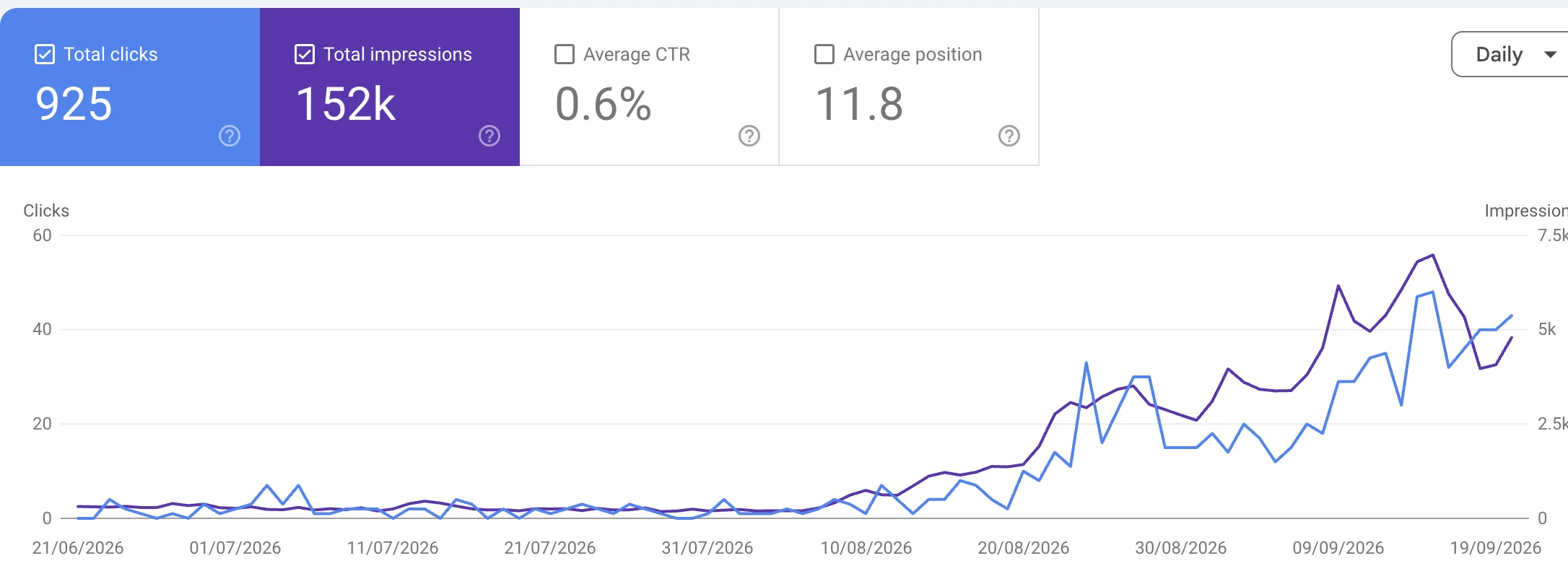
That average position is the honest detail. At 11.8, a lot of Versely sits on the edge of page one. That's exactly where title rewrites pay off, and why we still work on them every month.
Rules if you're about to scale content
If you're sitting on a content engine and a big backlog, here's what we'd do differently from day one:
- Start slow and earn speed. Pick a daily ceiling well below what your pipeline can produce. Raise it only while new URLs are getting indexed.
- Watch the Page indexing report weekly. The trend in "Crawled – currently not indexed" is your early warning.
- Gate for duplicates before publishing, not after. One strong page per query beats three similar ones.
- Noindex or merge thin variants. Don't make Google pick between your own pages.
- Fix titles on page 1–2 rankings first. It's the cheapest traffic you'll ever get.
- Keep
lastmodhonest and link every new page from somewhere relevant. - Make sure the right crawlers can reach you. Check your robots.txt with our free AI crawler checker, and see the rest of our free SEO tools.
None of this is secret. It's just slower than people want. We learned it the expensive way so you don't have to.
Where this playbook lives now
Everything above, the pace limits, the gates, and the Search Console title loop, is what we're building into Autopilot. It's in early access while we finish it. If you'd rather start with links and discovery, a free launch on LaunchRanked gets you a permanent product page and a followed link after review, and our guide to directory submissions in 2026 covers what still works there.
Frequently asked questions
How many blog posts per day is safe to publish?
Google doesn't publish a number. On Versely, our own product, we settled on about 20 posts a day after a month of roughly 2,500 posts got throttled. A newer or smaller domain should start slower and speed up only while the Page indexing report stays healthy.
What does "Crawled - currently not indexed" mean in Search Console?
Google's definition: the page was crawled but not indexed, and it may or may not be indexed in the future. There's no need to resubmit it. In practice it means Google saw the page and decided it wasn't worth indexing yet, so improve, merge or noindex it.
Should I delete pages that Google won't index?
Not in a panic. Group them first. Near-duplicates should be merged or noindexed. Thin pages should be improved or folded into a stronger page. Pages that are genuinely useful often get indexed later once the rest of the site is cleaner.